Glossary
Quick definitions of key terms
Guides, glossaries and calculators to help you scope, cost and run an ERPNext implementation — from GST and e-invoicing setup to module-by-module walkthroughs.
Quick definitions of key terms

Expert insights and updates
Simple step-by-step resources

Easy explanations through videos.
Complete IRN flow in ERPNext (2026)
ERPNext HRMS for India's Labour Codes
ERPNext for Indian hospitals (NABH, ABDM, DPDP)
DPDP Act 2023 Compliance in ERPNext


Certified ERPNext implementation expert
Trusted by 150+ businesses across India and globally - from fast-growing SMEs to listed enterprises. Finstein delivers end-to-end ERPNext implementations that are faster, leaner, and built to scale.


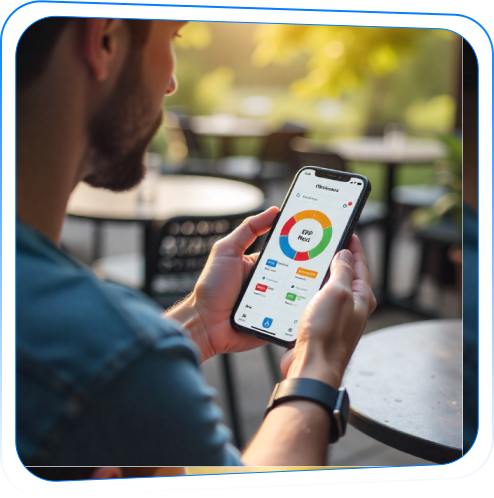
Run your entire business on one platform. ERPNext is a full-suite open-source ERP - cloud-ready, GST-compliant, and built for real Indian businesses.
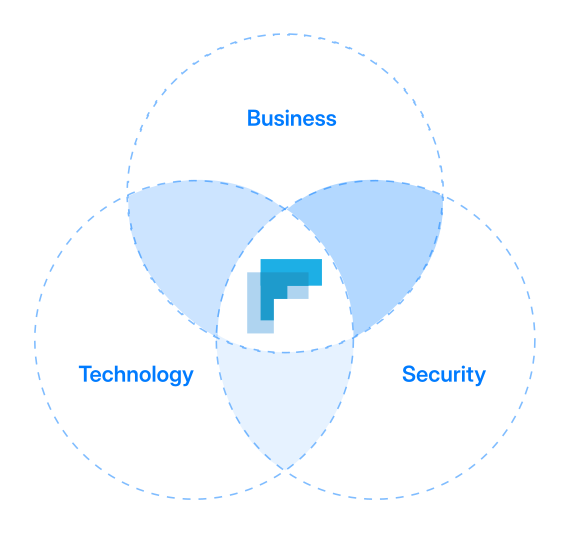
Our solutions sit at the intersection of Business, Technology, and Security

Avoid vendor lock-in and license inflation. Configure quickly, iterate faster.
Trusted by 150+ SMEs and enterprises across India, UAE, and the US - from Chennai to global scale.

Maximize floor productivity and eliminate stockouts with real-time BOM tracking and precision production planning.

From day one, Frappe ERPNext brings finance, operations, and people into a single, reliable system. As a leading ERPNext partner India, we provide expert ERPNext consulting and ERP for SMEs in Chennai, Mumbai, and Bangalore.

Close faster with GST-compliant ERP features: ledgers, multi-currency, e-invoicing, and automated journals for India.

Know what's where bins, batches, serials, stock ledger, reorder points, and guided putaway/picking to reduce stockouts.

Move from lead to invoice without the swivel chair quotes, orders, pipelines, and email/SMS built in for predictable revenue.

Bring spend under control with supplier quotes, POs, GRNs, landed costs, pricing rules, and approval flows.

Plan and execute with confidence BOMs, routing, capacity planning, work orders, quality checkpoints, and subcontracting.

Manage your team with robust HRMS software employee records, attendance, shifts, and accurate payroll matching India regulations.

Stay on schedule and in profit tasks, timesheets, budgets, milestones, and cost-vs progress tracking in one view.

Track the full lifecycle acquisition, depreciation, maintenance schedules, and compliance-ready records.

Sell anywhere with product catalogs, carts, payments, and unified stock & accounts plus ERPNext POS for in-store speed.
Join 150+ businesses already running smarter on ERPNext. Book your free 1-on-1 demo today - no commitment, no sales pressure.
Get answers to common questions about ERPNext implementation and pricing from a preferred ERP partner Chennai.
ERPNext is an open-source, all-in-one ERP that unifies Finance, HR, Inventory, Sales, and Manufacturing. It reduces IT costs by 40-60%, ensures GST/TDS compliance, and gives leadership real-time visibility into every corner of the business.
Unlike SAP or Oracle, ERPNext is an open source ERP vs SAP choice that eliminates license fees, offering a much lower ERPNext cost while matching enterprise-grade functionality. It's the ideal ERP for SME India markets.
Yes, ERPNext has a powerful REST API that allows seamless integration with third-party applications like Shopify, WooCommerce, Amazon, payment gateways, and other legacy systems.
SMEs can go live in 6–12 weeks; larger enterprises typically take 3–6 months. Finstein's phased methodology ensures zero business disruption at every stage.
We provide 24/7 ERPNext support, upgrades, bug fixes, and SLA-based maintenance, along with module expansion and integrations.
Yes, ERPNext is cost-effective, scalable, and easy to customize, making it ideal for SMEs and startups.
We offer role-based ERPNext training for finance, HR, sales, and operations with documentation and workshops.
ERPNext uses SSL, 2FA, backups, and role-based permissions. With Finstein hosting on AWS/Google Cloud, security is enterprise-grade.
ERPNext has no heavy licensing costs. Ongoing costs include hosting, support, and upgrades, with transparent pricing models from Finstein.
Mid-market ERPNext implementations in India typically range from INR 6 Lakh to INR 35 Lakh depending on scope, users, integrations, and customizations. Finstein publishes a fixed-price proposal before contract — no hourly surprises. Annual hosting and support typically adds 15–20% of the implementation cost per year. The full line-by-line breakdown is in our implementation cost guide at /guides/erpnext-implementation-cost-india.
Over 5 years, ERPNext TCO for a 50-user Indian SME is typically 20–30% of SAP Business One. License fees are zero (vs. INR 1.5–2.5 Lakh per user for SAP B1), and infrastructure cost is lower on open-source-friendly clouds. Finstein's TCO calculator at /calculator gives a detailed side-by-side estimate for your specific profile.
No license fees, ever — ERPNext is fully open source. Real costs are implementation, customization, hosting, and support. Finstein quotes all four upfront in a fixed-price SOW. Customizations outside the quoted scope are billed transparently at documented day rates.
Managed hosting from Finstein starts at INR 12,000 per month for a 25-user deployment on AWS Mumbai, including daily backups, SSL, and 99.9% uptime SLA. Larger clusters and HA setups scale linearly. Customers with existing AWS or Azure accounts can self-host; Finstein provides only the ERPNext stack.
For manufacturing, yes — significantly. Tally is an accounting tool; ERPNext runs the full shop floor: BOM, work orders, subcontracting, multi-level production, batch/serial tracking, MRP, and cost rollup. Tally has none of these natively. Most Indian manufacturers outgrow Tally by their second plant or 50th SKU.
Zoho Books is a solid accounting SaaS for sub-25-user SMEs that don't manufacture or hold inventory. ERPNext wins the moment you need inventory, manufacturing, projects, or multi-entity consolidation. Finstein's calculator shows the break-even user count for your profile; for most growing SMEs, ERPNext becomes cheaper and more capable past 15 users.
For most mid-market companies (INR 25–500 Cr turnover), yes. ERPNext covers finance, inventory, manufacturing, HR/payroll, CRM, projects, and asset management — the same core coverage as SAP Business One and most SAP ECC mid-market rollouts. Finstein publishes a capability gap analysis before contract so you see exactly what is covered, what is configured, and what is custom.
Yes. ERPNext supports unlimited warehouses with real-time stock levels, inter-warehouse transfers, per-warehouse valuation, batch/serial tracking, and GST-compliant e-way bill generation for inter-state movement. Finstein has rolled out ERPNext for distributors with 40+ warehouses across all Indian states.
Yes, natively. ERPNext generates IRN-stamped e-invoices through the NIC API, auto-creates e-way bills for qualifying shipments, and exports GSTR-1, GSTR-3B, and GSTR-2A reconciliation files directly. Finstein configures the GSP connection during implementation; clients go live fully GST-compliant.
Yes. Finstein has production integrations with Shopify, WooCommerce, Amazon India (MWS/SP-API), Flipkart, Meesho, and Myntra. Orders, inventory, pricing, and returns sync bidirectionally. Custom integrations for niche marketplaces are typically delivered in 2–3 weeks.
Finstein's standard Tally migration covers masters (chart of accounts, customers, suppliers, items, opening balances), open transactions, inventory valuation, and prior-year trial balance — reconciled to the rupee. Typical migration runs alongside configuration in weeks 5–8 of a 12-week implementation, with a sandbox cutover test before go-live.
On day one we request: latest trial balance, chart of accounts, customer and supplier masters, item master with UOMs and GST rates, opening stock with valuation, open sales orders and purchase orders, open AR/AP, and prior-year P&L. Finstein provides an Excel template for each; most clients need 2–3 weeks to clean and sign off the data.
Role-based training typically runs over 2 weeks in the back-half of implementation: 1 day per module for power users, half-day per module for end users, plus a sandbox drill week. Finstein delivers SOPs, short videos, and a role-specific user manual. Post-go-live, the 90-day hyper-care covers floor-walk support and refresher sessions.
Finstein is a certified ERPNext implementation partner trusted by 150+ businesses across India and globally, from fast-growing SMEs to listed enterprises. With delivery teams in Chennai and Mumbai, Finstein runs the full lifecycle - discovery, configuration, data migration, GST-ready go-live, and 24/7 support - using a phased methodology that keeps operations running. When choosing an ERPNext implementation company, look for certified consultants, a proven deployment track record, and transparent fixed-scope pricing.
ERPNext is customized through its low-code Frappe framework: custom fields, doctypes, print formats, workflows, role permissions, dashboards, and server/client scripts - all without editing core code, so upgrades stay clean. For deeper needs, Finstein builds custom Frappe apps and REST API integrations. The recommended path is to map your process first, configure the standard modules, then add targeted customizations only where they add measurable value.
For most Indian SMEs, ERPNext is the best-fit ERP: it is open source with no per-user license fees, GST and e-invoicing ready out of the box, and covers accounting, inventory, manufacturing, HR and payroll, CRM, and projects in one platform. It scales from 10 to 500+ users, so you will not outgrow it. Finstein helps SMEs go live in 6-12 weeks on managed AWS Mumbai hosting with SLA-backed support.
Finstein is a certified Frappe partner (Entry Level tier) with hands-on domain experience across manufacturing, distribution, retail, healthcare, and services. Every engagement includes documented SOPs, role-based training, a 90-day hyper-care period, and SLA-backed support - the experience, expertise, and accountability that matter most when choosing an ERPNext consulting and implementation partner.
Join 150+ businesses already running smarter on ERPNext. Book your free 1-on-1 demo today - no commitment, no sales pressure.
Book Your Free ERPNext Discovery Call - Tell us about your business and we'll map out exactly how ERPNext can solve your biggest operational challenges.


We will get back to you as soon as possible.